CartiVex Guides: Joint Health and Joint Supplement Buying
Written by the CartiVex editorial team
Last updated · Who reviewed this page · How we write and review
The CartiVex guides cover two topics: joint health habits backed by guidelines, and a checklist for choosing a joint supplement. Three blog posts explain curcumin doses in studies, why black pepper is added and how to spot fake reviews. A glossary defines eleven label terms, from curcuminoids and 4:1 extract to lot number and CoA.
CartiVex guides: two in-depth reads on joints
The CartiVex guides cover joint health basics and how to pick a joint supplement. Both are free and written for everyday readers.
Read the habit guide first, then use the checklist if you still want a capsule. Each card opens the full guide.
Joint Health Guide: Exercise, Weight and When to See a Doctor
What osteoarthritis is, which habits have the strongest evidence, the warning signs that need a doctor, and where turmeric fits.
Choosing a Joint Supplement: A Buyer's Checklist
Ten checks for any joint supplement, from curcumin dose to seals and red flags, then applied honestly to CartiVex.
CartiVex blog: curcumin doses, black pepper and fake reviews
The CartiVex blog answers one question per post. Three posts cover what readers ask most about turmeric capsules.
Each post links its sources, so you can read the studies for yourself.
Turmeric for Joints: How Much Curcumin Do Studies Use?
The daily doses in knee trials and reviews, set beside what a typical capsule holds.
Black Pepper (BioPerine) in Turmeric Capsules
Where the 2000% absorption claim came from, and the medicines piperine can affect.
How to Spot Fake Joint-Supplement Reviews
Anonymous review pages, illustrative testimonials and the claims worth doubting.
Which CartiVex guide fits your question?
Match your question to one read below. Most people need the habit guide first and the checklist second.
- Sore knees or hips and unsure what helps most? Read the joint health guide.
- Comparing two or three joint labels? Use the joint supplement checklist.
- Wondering if a capsule holds enough curcumin? Read the curcumin dose post.
- Taking prescription drugs? Read the black pepper post before you start.
- Not sure a review page is real? Read the fake reviews post.
CartiVex glossary: joint supplement terms in plain English
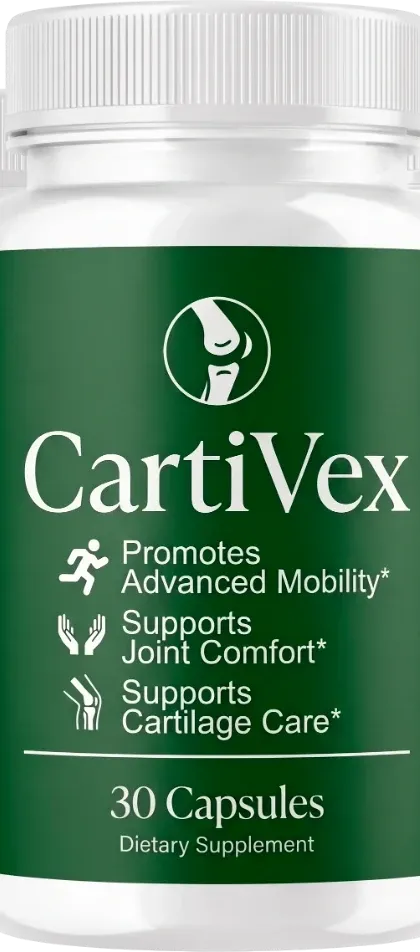
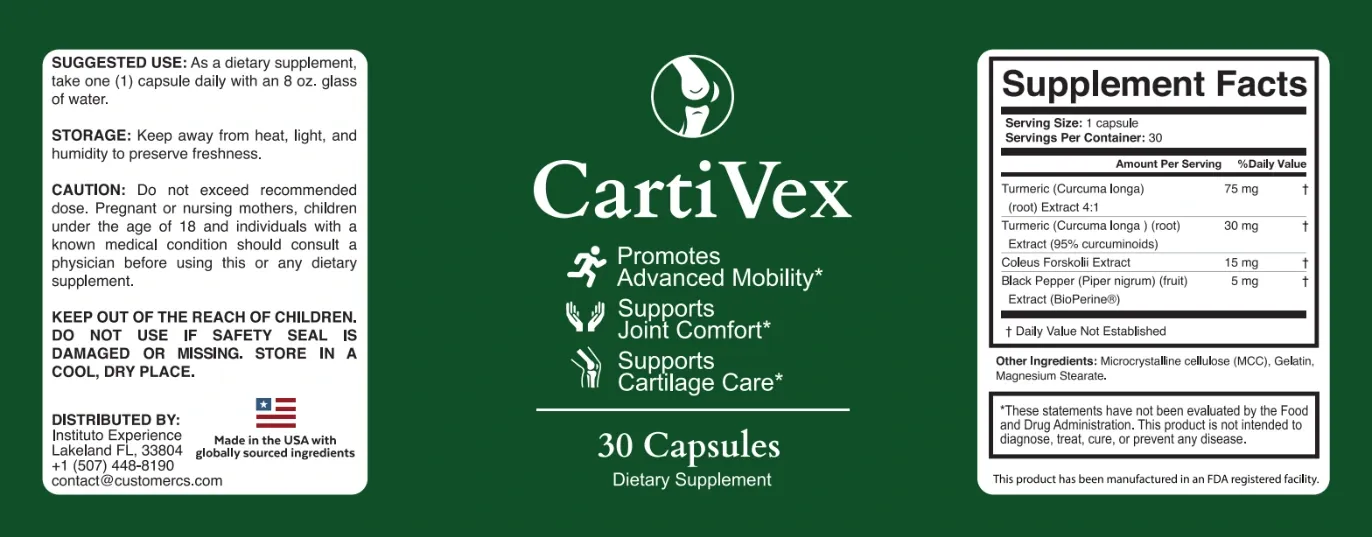
The CartiVex glossary explains eleven words that show up on joint supplement labels. The right column shows where each one appears on the CartiVex bottle.
Definitions follow the cited sources, such as NIAMS on osteoarthritis (NIAMS, n.d.) and the FDA on label claims (FDA, 2024).
| Term | What it means | On the CartiVex label |
|---|---|---|
| Curcuminoids | The yellow compounds in turmeric root. Curcumin is the main one. | About 28.5 mg from the 95% extract |
| Standardized extract | An extract tested to hold a set share of a marker compound in every batch. | Turmeric extract, 95% curcuminoids, 30 mg |
| 4:1 extract | About four parts of raw root went into one part of extract. It is a strength ratio, not a compound amount. | Turmeric 4:1, 75 mg; curcuminoids not stated |
| Piperine and BioPerine | Piperine is the sharp compound in black pepper. BioPerine is a branded black pepper extract. | Black pepper fruit extract, 5 mg |
| Forskolin | A compound in Coleus forskohlii root, studied mainly for weight. | Coleus extract 15 mg; forskolin share not stated |
| Glucosamine and chondroitin | Compounds found in cartilage and sold as joint supplements. Study results are mixed. | Not in the formula |
| Osteoarthritis | A disease of the whole joint, not just wear and tear. | No disease claim on the label |
| Structure/function claim | A claim that a product supports a normal body function. It needs the FDA disclaimer. | Promotes Advanced Mobility*, Supports Joint Comfort*, Supports Cartilage Care* |
| Daily Value dagger | A mark meaning no Daily Value has been set. | On all four active lines |
| Lot number | A batch code that ties a bottle to one production run. | CV-26/GO-8059, a draft label |
| CoA | Certificate of Analysis: a lab report for one batch. | CV-8059-26-GO, a draft label, not lab proof |
How to read a joint supplement label like the CartiVex desk
The CartiVex desk reads every joint label in the same four steps. You can use them on any bottle, in a store or online.
- 1
Find the serving
Check how many capsules make one serving and how many servings fill the bottle.
- 2
Work out the active amount
Multiply by any purity figure. 30 mg at 95% curcuminoids is about 28.5 mg.
- 3
Compare with research
Look up the daily dose used in human trials for each line.
- 4
Scan the claims
Supports wording is normal. Treat, cure or rebuild wording is a red flag.
What the CartiVex guides found about its doses
The CartiVex guides set each label amount beside the doses in human studies. Every line comes in far below them.
That does not make the capsules unsafe. It means study results cannot predict what this bottle will do.
The 75 mg 4:1 extract adds some curcuminoids too, but the label does not say how many. The guides treat that amount as unknown rather than guess it.
- Curcuminoids: about 28.5 mg stated, while knee reviews used about 93 to 2,000 mg a day (Paultre et al., 2021)
- Single knee trials: 1,500 mg a day, split into three doses (Kuptniratsaikul et al., 2014)
- Piperine: 5 mg, against the 20 mg behind the famous absorption result (Shoba et al., 1998)
- Coleus: 15 mg, about 3% of the 500 mg used in weight trials (NIH ODS, n.d.)
- Glucosamine, chondroitin and collagen: none, despite the cartilage care claim
How the CartiVex guides use research
The CartiVex guides lean on systematic reviews, clinical guidelines and government fact sheets. Each research line names the dose and links the source.
The guides also report findings that do not favor turmeric. A large review rated the curcumin evidence very low quality (Liu et al., 2018), and the guides say so.
Guidelines
Expert advice on what to try first, such as the 2019 osteoarthritis guideline.
Reviews
Studies that pool many trials and weigh their quality.
Fact sheets
NIH, NCCIH and FDA pages on safety and label rules.
Who writes and checks the CartiVex guides?
The CartiVex editorial team writes every guide and post from the label, the linked studies and NIH, NCCIH and FDA pages.
Each guide is medically reviewed by our medical reviewer, Dr. Teo Mendez, MD, Physician, for accuracy against the label and the cited sources. This is general information, not personal medical advice.
When a source changes or a link breaks, the team rechecks the claim and updates the date. A fact that cannot be traced to a source comes out of the guide.
What the CartiVex guides will not tell you
The CartiVex guides stick to what the sources support. Some things never appear, however often people search for them.
- That a capsule cures arthritis or regrows cartilage
- That turmeric replaces a pain medicine your doctor prescribed
- A timeline for results that the seller never published
- A customer rating or review that nobody has verified
Questions about the CartiVex guides
Questions people type into Google and Bing, answered from the label and the sources on this page.
Are the CartiVex guides free to read?
Yes. Both guides and all three blog posts are free. There is no sign-up form, email wall or paywall in front of any of them.
Are the CartiVex guides medical advice?
No. They explain public research and label facts in plain words. Questions about your own joints, tests or medicines belong with your doctor.
Which CartiVex guide should I read first?
Start with the joint health guide. Exercise, weight and knowing when to see a doctor matter more for sore joints than any capsule.
Do the CartiVex guides say the product works?
No. They describe studies of single ingredients, not of the finished formula. They also show where the label amounts fall short of those studies.
What is the difference between curcumin and curcuminoids?
Curcuminoids are a small family of yellow compounds in turmeric root. Curcumin is the main member, and labels often use the two words loosely.
What does a dagger mean on a Supplement Facts panel?
A dagger in the Daily Value column means no Daily Value has been set for that ingredient. All four active lines on the CartiVex label carry one.
What is a structure/function claim?
It is a label claim about supporting a normal body function, not treating a disease. The FDA does not approve it first, and it must carry a disclaimer (FDA, 2024).
Do the CartiVex guides cover rheumatoid arthritis?
Only briefly. The guides focus on osteoarthritis, the most common type of arthritis. Rheumatoid arthritis is a different disease that needs a doctor's care.
How often are the CartiVex guides checked?
Each guide shows a Last updated date near the top. The latest full check of every source link finished on October 12, 2026.
Can I suggest a topic for the CartiVex guides?
Yes. Email [email protected] with the question you want answered. Topic ideas from readers shape which posts come next.